DiamonDyze Ceramic Anodising
DiamonDyze is a ceramic anodising process for aluminium that matches or beats hard anodising for hardness and wear, while adding practically zero dimensional growth and a full range of colours. It is applied exclusively in the UK by Camcoat Performance Coatings.
What it is
Ceramic and aluminium oxide, combined within the base metal
Anodising aluminium has been around for nearly a hundred years. The three established types each have a downside, whether in hardness, wear, corrosion resistance, choice of colour, or component growth.
DiamonDyze works differently. By altering the usual anodising parameters, micro ceramic materials are introduced into the pores of the base metal during the anodising process. That combination of ceramic and aluminium oxide within the metal itself is what gives DiamonDyze its surface properties.
The result is a dense, low friction, hard wearing surface that behaves like hard anodising but without the dimensional growth, and with colour available across the range.
Characteristics
- Harder wearing than hard anodise
- No part growth
- Over 8,000 hours successful salt spray test
- A dense, low friction surface
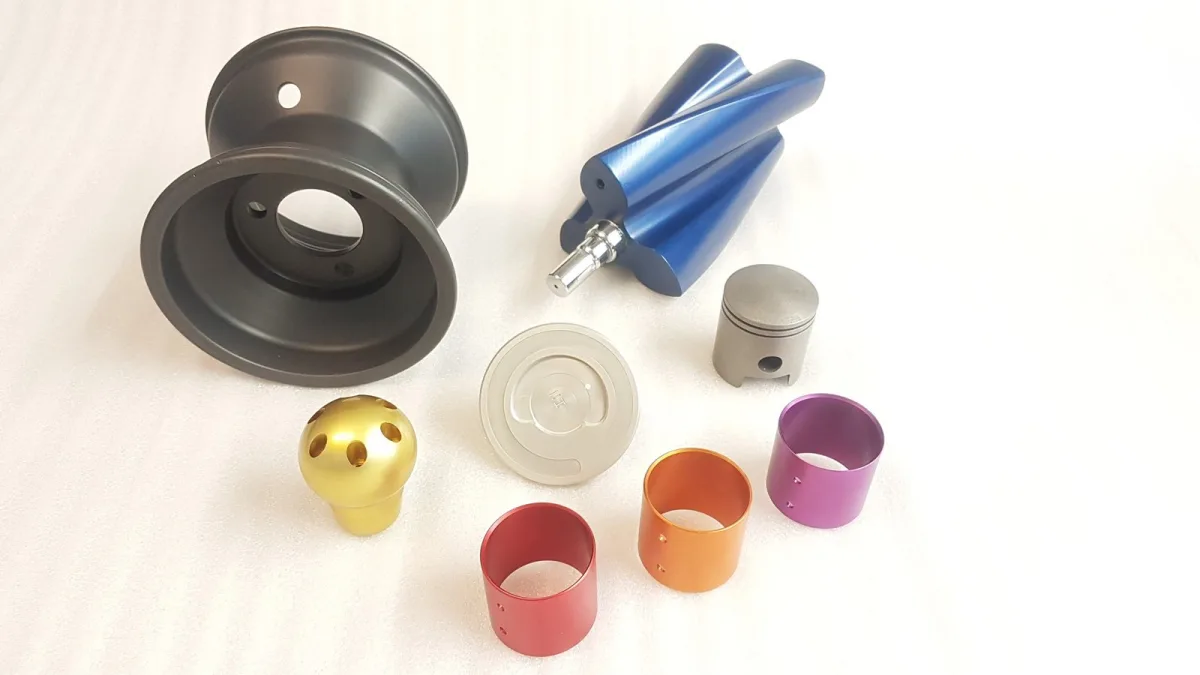
- Full range of colours available
- Suits most grades of aluminium
How it compares
The four types of anodising
Each established type of anodising trades something away. DiamonDyze was developed to remove those compromises.
Chromic acid
A minimum thickness of 18 microns, giving excellent corrosion resistance. Used mainly on products that must withstand continuous outdoor exposure.
Sulphuric acid
A thinner coating at 10 microns minimum, so it is restricted to applications where outdoor exposure is not an issue, or where the item is cleaned regularly.
Hard anodise
A thicker coating at a minimum of 25 microns, giving exceptional durability where corrosion and wear are the key factors. Parts grow dimensionally as it is applied.
DiamonDyze
Equal or better hardness, smoothness and wear resistance than hard anodising, applied so that dimensional growth of the item is practically zero.
Why it matters
Machine to final size, then anodise
Because DiamonDyze adds practically no dimensional growth, aluminium components can be machined to final specification and even threaded, with no need for post anodising remachining.
- No allowance needed for coating thickness
- Threads can be cut before anodising
- Low friction gives threads a freer fit than bare metal
- Colour coding available alongside the wear properties
- Comparable in cost to Type III hard anodising
- Can be used alongside Camcoat ceramic coatings
Applications
Built for smaller precision components
Aluminium is the prime candidate metal and most grades can be treated. The surface properties and the nature of our facility mean DiamonDyze suits smaller precision components rather than large architectural structures.
Colour coding is often as important as the wear properties. Medical equipment where different and often corrosive gases are used is a good example, where black alone would not be enough.
For aluminium components that also need thermal management, DiamonDyze can be used in conjunction with our performance coatings, including piston coatings and engine internal coatings.
Find us
Send your components in from anywhere in the UK
Questions
DiamonDyze FAQ
What metals can be DiamonDyzed?
How is DiamonDyze different from hard anodising?
Will my parts grow in size?
How corrosion resistant is it?
What does it cost compared with hard anodising?
Can it be combined with your ceramic coatings?
For the background on how the process was developed, read our DiamonDyze history article, or see the technical data sheets.
Got an aluminium component in mind?
If you have, or know of, a product that would benefit from DiamonDyze ceramic anodising, get in touch and we will tell you what is possible.